

Af Fidon Mwombeki
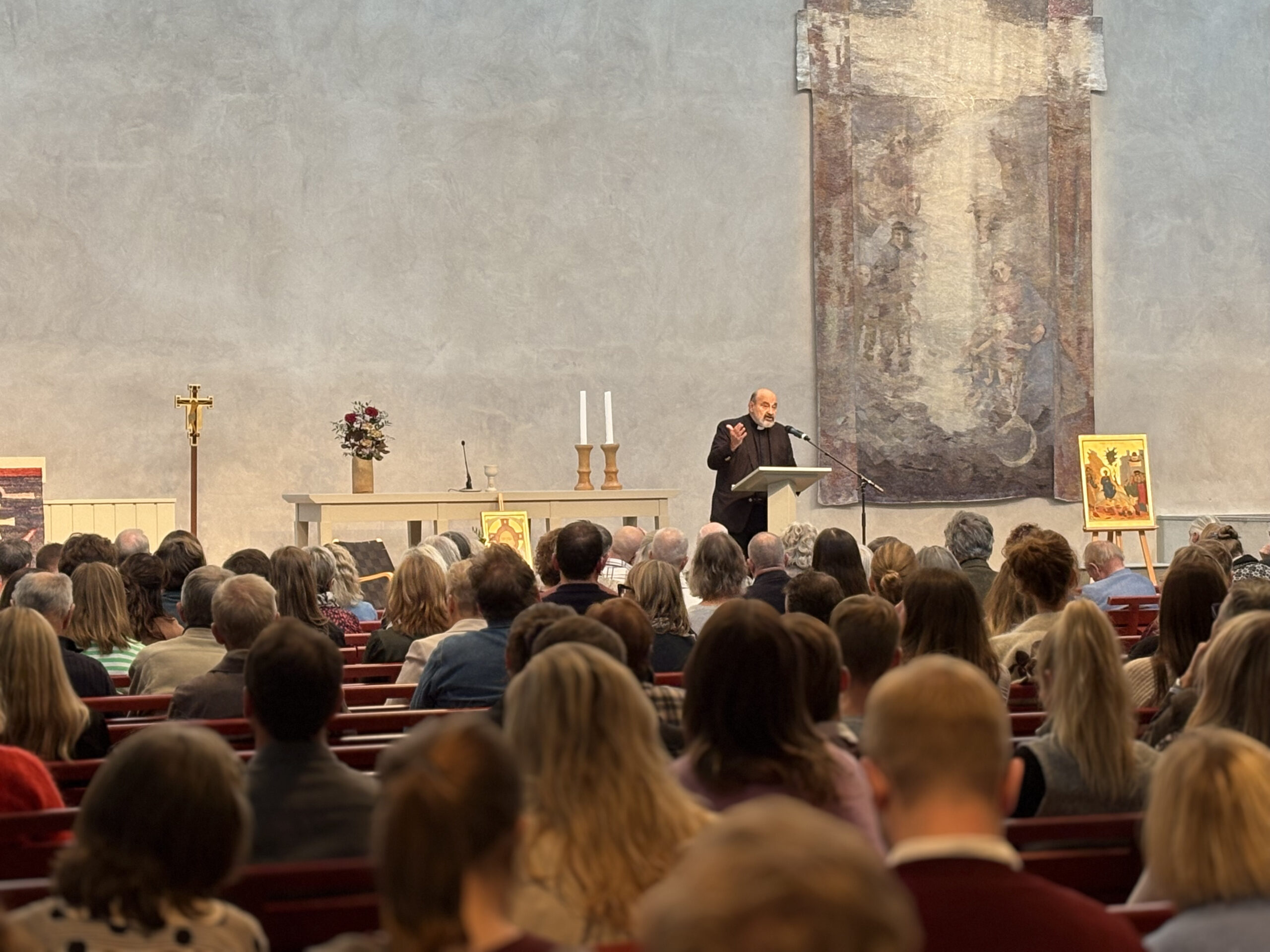
Denne artikel er en lettere redigeret udgave af Fidon Mwombekis foredrag til Dansk Missionsråds og Center for Kirkeligt Udviklingssamarbejdes fællesseminar på Nyborg Strand den 13. maj 2025.
Introduction
I am indeed grateful to have this opportunity to be part of this event, which is indeed based on a commitment to equal partnerships around the world. I have formulated my presentation under the title: Partnership in post-colonial realities. I will explain why. I wish to draw from my experience as a former General Secretary of the United Evangelical Mission with offices in Germany. It is a successful attempt to transform an old German mission organization into a vibrant international mission agency, called “A communion of Churches in Three Continents.” I recognize the same passion and sincere desire even among you here, to seek and achieve equitable partnership, among the churches. Success needs serious, long-term investments and resilience.
Understanding the terminology
There are several words around the world in the attempt to express this effort. Some call it decolonization. Or decoloniality. None of the words do not have issues. I am proposing to use the word post-colonial because honestly, I do not know who is decolonizing whom and who says someone is still colonized. It is in the broader conversation on “postcolonial theory”.
Foundational questions
In post-colonial realities, we attempt to identify, analyze, and deconstruct the effects of colonialism. It is an attempt to challenge the assumption that European ideals, thoughts, methods, approaches, and experiences are the standards on which every other culture should be measured, to determine whether they are civilized or not, appropriate or not.
Colonialism is not only the issue of territorial acquisition and occupation, otherwise many countries which never had colonies would be left out the discussion. We are talking about the consequential colonization of the mind, that influences perceptions of oneself, for both the colonized and the colonizer, and broadly is absorbed in their societies to collectively form a permanent mindset. It is on that basis Denmark can be seen as colonial to Africa, where it had no colony.
Territorial colonialism ended in Africa more than 60 years ago, but we are still talking about it. Most of the people now working in churches, in politics, and in business have been born in politically independent Southern hemisphere. Us in the generations after official colonialism ended, we are still grappling with the engraved effects of that injustice which have contributed to the actual life situation and institutions in the globe today. We are talking about legacies of colonialism.
Was church part of the colonial story? Were missions colonial enterprises? These are questions to which I hope my answer is well-known: We in Africa and Asia make a clear distinction between colonialists and missionaries. We know we welcomed missionaries, who lived with us, shared with us the good news, and served us in our communities. We as Christians admire these people until today, as we know they were convinced that they had received a calling from God and came to us, many until they died and chose to be buried among us. They did not steal from us our land or property. Indeed, they took some artifacts, some were bought, while 0thers were given as gifts out of our generosity, and brought them to their museums, mostly out of reverence. However, we are aware that some did terrible things. We know also colonial powers took land from us, making it their own, oppressed our people, divided our communities, gave us new things called “countries” without regard to demographic identities of people, legislated laws to keep us under oppression. Therefore, we asked them to leave, or we fought them and expelled them.
On several occasions, missionaries were expelled by colonialists because they defended the native people. The native people invited back their missionaries time and again. They were asked to come back time and again.
This is the basis of partnerships between churches in the past and today. They were built on such an understanding. We acknowledge together what was wrong, but we appreciate also the sharing of the gospel and the relations which have continued until today.
Nevertheless, both the native Christians and the missionaries could not escape the colonial context in any way. And the impact of colonialism definitely affected both the Europeans and non-Europeans, particularly in terms of identity, power, and culture. It is in the same spirit that independence movements swept, not only through the political spheres, but concurrently the ecclesial spheres as well.
Looking at the legacies of colonialism today, we see that the major social and political realities of the whole world today are a result of European colonialism. The languages used internationally, the geographical boundaries of countries, the international institutions, including the United Nations and others, they are a heritage of European colonialism.
The only thing that did not succeed fully is religion. While all of Europe was Christian at the time of colonialism, Europe succeeded only in Africa and Latin America to have significant numbers of adherent. Christianity did not succeed in the majority of the world population, which is in Asia, even though they were also somewhat colonized. That is why, the decision and plan to “evangelize the world in this generation” made at Eurocentric “Edinburgh 1910”, when Christians formed only 30% of the world population, has ended 110 years later with the same 30% of the world being Christian.
Church partnerships
Church partnerships are built on the desire and commitment to decolonize on both sides. We consciously look for the heritage of colonialism and want to deconstruct and eliminate them. Here we are talking about partnerships between Northern churches and Southern churches. In many instances, they are in fact based on the colonial history. These are indeed in the trajectory of colonialism. Most of churches in partnerships (am very aware not all) are among those who share colonial history. That is in itself a heritage. What I am going to say below is based on the realization that both Africans and Europeans have other partnerships. Churches in Germany for example, have partnership with other European and American churches, just like Africans have partnerships with other African churches, including in the same countries. Such partnerships, which have no shared colonial history, function with totally different assumptions and operate differently.
In this presentation, we want to focus on the colonial heritage which still can be traced and analyzed.
I will mention only four axes which I identify as mirrored in church partnerships.
Superiority-inferiority axis
Both the colonizer and colonized have a mindset which ascribes superiority to the colonizer. In this case, the Europeans are superior to all others. They may not want it, but I am not sure the feeling is gone. Africans, in general, feel Europeans are superior in different ways, that is why even young people do whatever it takes to go to Europe. I know it for sure that that many people in partnership deep down in their minds and hearts see others in light of the colonial mindset. While we acknowledge that the humanness of each one of us is the same, there are certain aspects which are easy to look at in terms of superiority. These include economic, social, even culture aspects.
I remember the church in Cameroun which asked me to find a board member of their bank from Germany, with the argument that if the other board members would sit with a German member, they will not take corrupt decisions. But, on the other hand, I saw also the superiority feeling of Europeans over others. Whether justified or not, it is there. It is sometimes veiled. But let me give an example of the reports I read in UEM from North-South volunteers. Most of them reported about misery, poverty, corruption, dependence they encounter. They do not make the stories up. They report the truth. But very seldom did I read reports of successes and great achievements they discover. Many want to prove that indeed these Africans are needy people, disorganized, ignorant who admire the white people. But conversely, the South-North volunteers, if they ever see the misery, poverty, corruption in Europe, they do not report them heavily. I wonder whether they are exposed to them in the first place. And Africans want to prove that this is a superior culture and society, almost lacking nothing.
Giver-receiver axis
The next axis, which we have always talked about, is the giver-receiver relationship in partnership. Of course, this is linked not only to the superiority-inferiority axis, but to realities of economics and perception of power. A giver feels a bit superior to the receiver, in every society. This is not only in a colonial setting, but even in a family setting, or any other. The one who gives has a sense of power over the receiver. It is not a secret even in the EU, the rich countries meet and make decisions among themselves first, and then they invite the others later—except the non-conventional Victor Orban who seems to disrupt the trend. To be either receiver or giver is not easy as it relates to power relations. A partnership of those with seriously different levels of economy is by nature bound to dance around the feelings of equality. Those who feel equal, are those who are able not only to give, but also to receive with joy, like we exchange gifts in family.
In partnerships, even after so many years of work, it is difficult to overcome the reality and mindset that Europeans have more and are expected to give. Africans are good givers by nature. Looking at what they do in their churches, how much money they contribute for different functions, and many investments they are making, they are rich and can give. We just finished the General Assembly of AACC in Abuja, Nigeria. The 14 Nigerian churches collected more than 200,000 USD to pay for all accommodation, meals, and local transport of more than 500 participants for five days. But many of these same churches have not paid their membership fees in WCC or other international institutions. It is because the idea of giving money to send to Europe is just not feasible. But do Europeans even expect and would accept financial donations from Africa or Asia? For example, when I was a member of a congregation in Germany, we were discussing closing the kindergarten due to financial difficulties. I asked whether they would allow me to ask two very rich Jakarta congregations to collect money and send it through UEM to support the kindergarten for at least a year. The answer I got was: “Das ist schwierig.” Whether I could have convinced the Jakarta congregations to donate to a German church I cannot be sure. They would probably agree out of pride that now at last they are also somewhat richer than some Germans. Not a good reason, for sure. So, Europeans are happy to “receive” from Asia and Africa financially insignificant gifts, like a piece of music, a recipe for some dish, some drumming from Africa, some painting from a poor community, etc.
Until today in bilateral partnerships, Europeans are always adamant to receive project requests, with proper explanation from their partners. They never say exactly what they themselves want to receive, they make no requests. And Africans and Asians are happy to submit all types of project applications, even some I found terribly embarrassing, like asking for five pigs and 2o chicken for a women´s group, or ten roofing sheets. It is embarrassing to read adults in Africa approaching these young volunteers to beg for money, telling them about all their problems and expecting these boys and girls to solve them or at least look for money for them. I was very surprised during my years, when the churches in Africa said they do not want to receive donations from Europe or America due to differences in sexuality controversies, the most painful part I always had to answer was if indeed Africans do not want the money anymore. Even those churches which cut relations, always sought alternative ways to make sure money is sent and those churches found ways or excuses to continue receiving money.
At the All Africa Conference of Churches, we have many and diverse international organizations as partners. I sometimes remain surprised at some of them. Looking at the amount of money they give us in a year, with lengthy documents on rules and guidelines, and deadlines for reporting, I just see the same mentality of power/giving. Imagine sending to AACC a donation of $1000 and demanding an annual narrative and audited financial report. You must be joking. I prefer that we remain with them as non-funding partners, rather than continuing telling their constituencies they are donating for an important work to us. But this becomes a threat to our partnerships because they do not imagine partnership where we say we are beyond those tiny donations with little impact and many requirements.
This axis is manifest and mirrored in society.
Teacher-learner axis
The colonialist, from the position of superiority, is also a teacher. And the colonized is always a learner.
This still exists in our partnerships. I always noted the way the exchange co-workers are regarded on both sides. Africans see Europeans as teachers. Even when we try to explain that youth volunteers are high school graduates with no expertise, when they arrive there, they are seen as experts, and whatever they say is trusted. Some are asked to do things that surprise them, including in medical facilities. As long as he or she is European, white, sent to work in a health or education facility, they are seen and treated as experts and can be asked to perform some procedures, something which terrifies them.
But I also saw those exchange pastors in Germany. They are seldom given a congregational responsibility. They play only a supportive role as the congregation cannot swallow the idea of being taught by an African or Asian. They are criticized more. And many ask questions which show this colonialist mentality: “I hope you are learning what will help your people when you go back.” For them, Africans and Asians come to Europe to learn, not to teach.
This teacher-learner axis affects theological conversations. Who sets the agenda? Those who regard themselves as teachers, even do not accept the opinion of their perceived learners. For example, in matters of human sexuality, I often heard that Africans will eventually “understand.” “How they believe is what also Europe used to do some years back.” When Africans say we believe the Bible says this, Europeans think Africans are not yet developed enough, they will eventually catch up. On this axis, however, I see it changing quickly, as many African and Asian Christians no longer regard theological positions from Europe as correct or normative. After all, it has not helped to keep their churches vibrant or convince the Europeans themselves.
But it is not only about theology. It is about other aspects of partnership as well, including practices. Take the example of partnership contracts. Germans, without a contract they do not feel organized or secure enough. Their partners cannot understand how you sign a document to regulate a friendship. They do sign them only at the insistence of their partners, who sometimes put sanctions if contracts are not signed. But Africans and Asians forget about them immediately after signing.
Institutional-structural axis
Another colonial heritage is church structures. Missions started and diaconal institutions like schools and medical facilities as well as administrative structures of the churches followed. There are those ministries which were established during mission times, and the partners abroad felt obliged to keep them going, even when the situation on the ground had completely changed. Kindergartens, diaconal schools, Bible schools, hospitals etc. were established in the view of receiving funding from abroad. European partners struggle to keep these institutions running. The mentalities on both sides take time to accept realities and reform, even discontinue some of them which are no longer needed. Slowly this is changing, but some are in pain to see some of these structures go.
The future: What can and should churches do to bring about change?
The four axes manifest in different ways. Sometimes they are hidden, and sometimes they are obvious, according to the level of awareness one or a group has. Even the idea of this event is an indication of a genuine wish to really deal with these matters decisively and overcome. The concept of establishment of UEM itself is based on that same conviction. We want equality of the churches and people. But we still struggle with them until now. I would have some suggestions, to consider in addition to many which I believe you have as well.
Firstly, it is important to recognize that we are also part of the history and context we find ourselves in. None of us living today was ever a colonialist. But we are part of our societies with their histories, self-understanding, and mindset. Just as the missionaries then, without having any ill intentions, found themselves accomplices to the evils of colonialism, we are likewise conditioned by our contexts. We should not try to deny it. That we think the way we do, we are influenced by our own societies. Let us acknowledge that first, and act consciously.
Secondly, we must also acknowledge that it takes generations to change mindset. While we have been working tirelessly to build equitable partnerships, obstacles and tendencies of colonialities persist. We should not lose heart, but strive on since we have not yet achieved our goals.
Thirdly, churches need to play their part in changing the mentalities and tendencies in our societies. We are part of societies. Churches cannot change alone. But since churches are made of members of society, let us be active in society to work for change. This may include our interventions in political, social, cultural, and economic arenas. Continuing to challenge the tendencies of racism and segregation in our societies will go a long way to contribute to societal change.
Lastly, I plead with churches to avoid oversensitivity and self-incrimination on the matter of colonial heritage. The goal of partnership is to build relationships based on equality. But I sometimes wonder if we do not overemphasize coloniality and use this term to exploit the other or relegate our responsibilities and quietly continue to regard or treat the other differently.
One result of this oversensitivity is to bring fear of the partner e.g., some theological discussions cannot be discussed because of the fear of offending the partner. We are afraid of expressing what we think is wrong to the partner out of fear of being labelled colonial. We avoid constructive criticism. Let us be led by Jesus´s interpretation of what it means to love the other: “Do for others what you want them to do to you.” Or in this case, treat others respectfully as you would treat your own people.
Take the example of accountability. Do not avoid demanding accountability from the partner the way you would demand accountability in your own church. And do not refuse to be accountable to the partner by hiding behind feelings of guilt and the accusations of colonialism.
I encourage the partnerships to come to the level of trust, which means we can discuss, differ, take decisions, as equals. Using the conversation and perception of colonial heritage to avoid responsibility is a worse result.
Underlying dynamics: Economics and education
As earlier noted, these do not happen in a vacuum. Church partnerships operate in the whole context of global tendencies and realities. And there are two factors which play a big role: money and education.
First is money. We may pretend money is not, or should not, be of essence in our partnerships. That is not possible. Money comes with power and influence. Let us accept. We see it in politics and commerce as well. Only the rich countries at the time of the United Nations funding have veto power. But now they want to invite those countries with money now, like Japan and Germany, to be permanent members of the security council. The basis is who can pay more. And when they decided to cut off funding for refugee agency in Gaza, that’s it.
In our congregations in Africa and Asia, where I have checked, leadership of the congregation goes to those who are financially superior to others, who are also happy to be generous. It is not based on race. It is based on economics. The poor in every society, be they Roma in Europe, the black people in the Favelas of Brazil, the small poor states in the EU, their voices are weaker. This is the reality we are living in.
So, as long as there is financial dependency, let us not confuse it with colonial mentality only. It is economic. Because the South has fewer liquid resources, they will continue to be weaker in international relations. But, if and when, they feel they do not need financial assistance from their partners, sometimes the giver loses purpose in partnership. It should not be so.
Secondly, the issue of education. The more people are educated, the more they feel confident, even without many resources. Let us also agree that education in the South is still low and not accessible to many and not of high quality. That is a reality we may not ignore. That is why many in the South want to go to study abroad. Truly, education in the North is better and more accessible. Therefore, you have a generally better educated population which can analyze things and make informed decisions. This leads to superiority feelings or even academic superiority realities. I was always pushing delegates from Africa and Asia, when in UEM events, also to speak up. Only those with proper education, mainly from the North, were confident enough to stand up and make arguments and move motions. That is still with us, and we must recognize it.
The trends of the future
While I see these realities, it is good to end with what I see as the trends into the future. The very dramatic changes in the political, economic, and military dominance will change the worldview, which in turn will affect partnerships.
The world view is changing, and Europe and America are no longer the undisputed standard setters of the world. Due to economic expansion of the others and political as well as military multi-polarization, I see economic partnerships changing quickly. With dwindling support from our traditional donors, new openings are coming up. Take an example of Tanzania. They are building a railway line. The main contractor is a Turkish company, and some parts Chinese. They recently found a partnership in natural gas drilling and processing with an Indonesia gas company. Last week, a contract was signed for provision of insurance for the funding of the railway construction by the state of Poland. Hungary entered several bilateral relations with Tanzania. China is of course the biggest donor and lender to the scale Europe would take years debating and setting conditions. The formation of BRICS and intended expansion will definitely change the worldview, and I see the possibility of United Nations becoming a relic of the past colonial time.
At ecclesial level, we have been hearing from Europe itself that the church in Europe is no longer a standard bearer of social, ethical, and moral discourse there. We are hearing increasingly pessimistic projections of the church in Europe in the next few decades. How does that change the colonial heritage of the churches in Europe being the source of theology, ethical debates, and financial sustenance?
As the saying goes, the only thing which does not change, is the assurance of change itself.
Foto: Missionærer, af David van der Kellen (1827–1895)